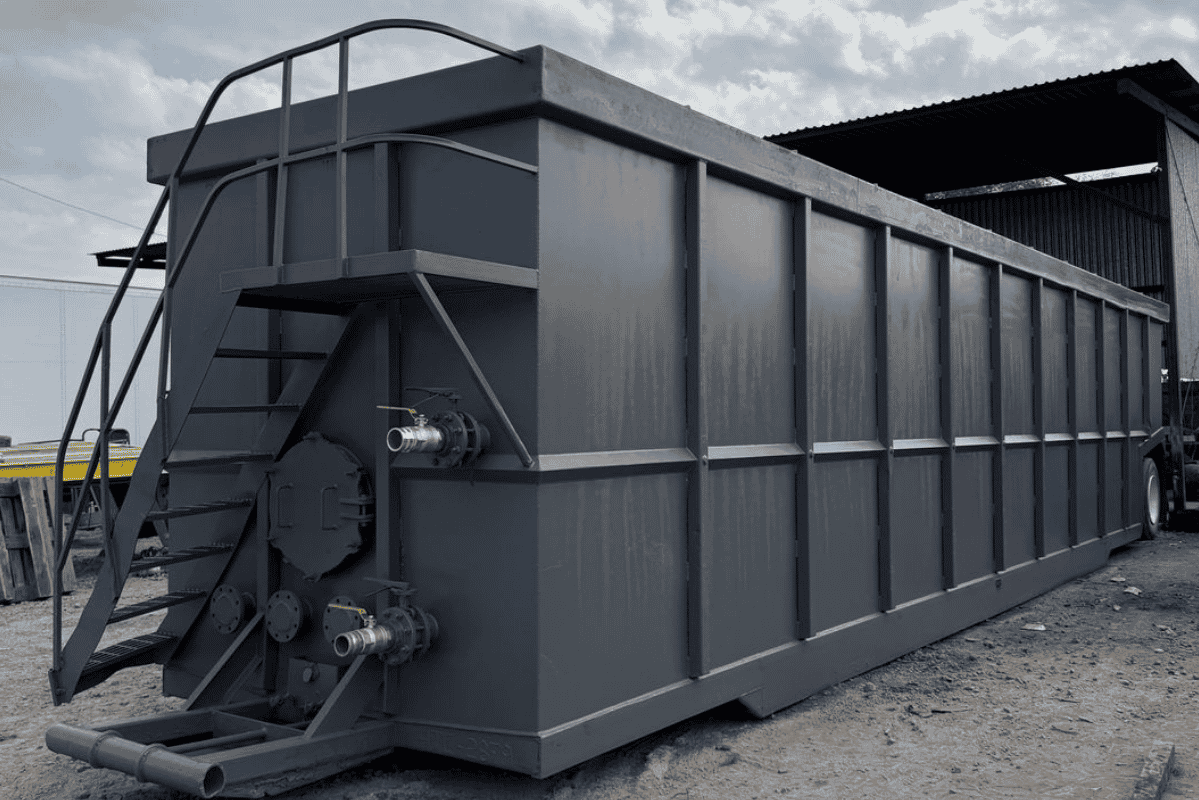
An 80,000-liter frac tank equals 500 barrels or 21,000 gallons of capacity for storing diesel at a job site. Choose a closed unit with valves and seals in good condition, and request a quote on Industrial Basanlo's 80,000-liter frac tank with verified specs.
Having a diesel fuel storage tank on site keeps your equipment from depending on constant trips to the gas station. A frac tank for diesel puts all the fuel in one place, so the buying decision should start from three data points: Capacity, unit condition and containment. This guide helps you evaluate each one before you ask for a quote.
A 500-barrel frac tank has a nominal capacity of 21,000 gallons, or about 80,000 liters. The conversion is simple: One barrel equals 42 gallons, and 500 barrels times 42 gallons gives 21,000 gallons.
Frac tanks dimensions depend on the manufacturer. The 500-barrel Dragon 2014 frac tank at Basanlo measures 45 ft long, 8.6 ft wide and 10 ft high, or 13.7 by 2.6 by 3.0 meters. Always confirm the measurements of the unit you choose before deciding where to place it, because the length requires maneuvering room.
Autonomy is calculated by dividing the tank capacity by your daily consumption. Daily consumption is what your equipment burns per hour multiplied by the hours it runs per day. Use the calculator with your own fleet data.
The result is an estimate based on nominal capacity. Usable capacity can be lower, so confirm it on the unit spec sheet.
A 21,000-gallon tank needs a containment plan before it arrives. Secondary containment, such as a dike or a perimeter pan, is meant to hold the fuel if the tank or its fittings fail. Define its location and capacity with your safety and environmental team, and confirm the configuration and permits that regulations require for diesel storage.
In the United States, the SPCC rule requires a spill prevention plan when total aboveground oil storage exceeds 1,320 gallons, according to the EPA overview of the SPCC regulation. A 21,000-gallon frac tank is far above that threshold, so confirm the federal, state and local requirements that apply to your site before you install one.
Fuel quality matters too: Diesel degrades over time and water is its biggest enemy. Keep the tank sealed, check valves and vents, and rotate your inventory so fuel does not sit idle.
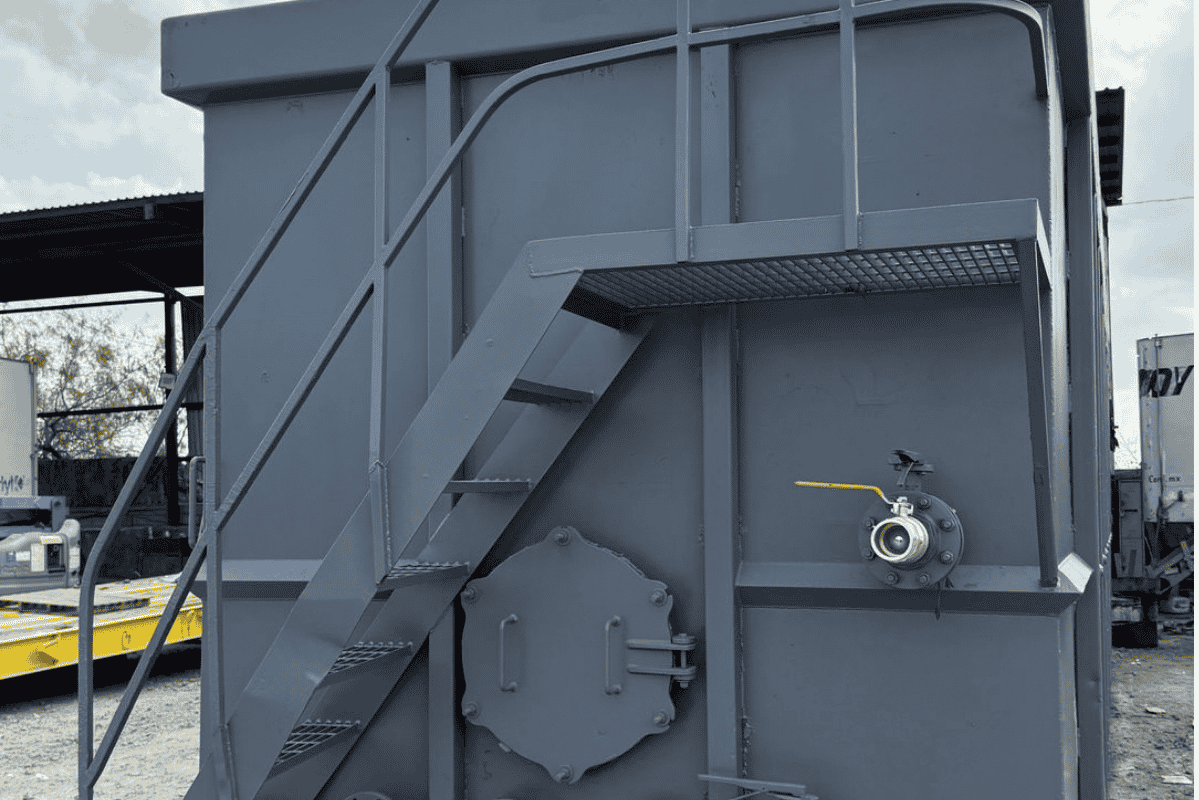
Industrial Basanlo has four used 500-barrel (80,000-liter) frac tanks available, imported from the United States: Two Dragon units, from 2014 and 2016, and two Herring units, from 2007 and 2014. All four are delivered inspected and tested, and Basanlo offers them for water, mud or diesel, as each listing states. All four share a 3-inch vent and relief line, a 4-inch rear bottom valve, working side and front manholes with 21-inch gaskets and a structure free of dents or damage.
The Dragon 2014 is a used 500-barrel corrugated wall frac tank imported from the United States, with an 80,000-liter capacity. Its functional 4-inch manifold connects to pumps or other tanks.
The Dragon 2016 shares the Dragon 2014 spec sheet: The same 500-barrel model, with a functional 4-inch manifold and 2 and 3 inch valves for smaller lines. Only the year of manufacture changes.
The Herring 2007 has two 3-inch front discharges, useful for working with two lines, and a 4-inch rear valve to empty the bottom.
The Herring 2014 has 4-inch front discharges, which empty at a higher flow rate and connect to 4-inch pumps and hoses with no reducers.
Sales coverage is nationwide in Mexico, with shipping from Monterrey to Mexico and the United States, and you can inspect the unit in Monterrey before confirming. Before you ask for a quote, have your daily consumption and the available space on site ready.
To compare every option, see our frac tanks and industrial storage tanks guide.
The right diesel tank for sale depends on your daily consumption, the space available and the containment you can guarantee. An 80,000-liter frac tank gives you a large reserve, but it only makes sense if the unit is closed, clean and backed by a verified spec sheet. Calculate your autonomy, go through the checklist and ask for the documentation in writing.
If you want to keep reading about heavy equipment, visit our guides and articles on the blog.


